
I'm going to meander back to my days in East Africa to bring up a current events topic that elicits a good snicker.
When we were in Tanzania learning Swahili, I managed to stumble onto all of the words for passing gas. Even though many Swahili words which come from English simply add an "i" to the end (like baiskeli for bicycle), it turns out that you can't discuss your footwear by saying "shoesi", as shuzi means "flatulence". Learning this did not stop me however from saying it, rather encouraging me all the more. I loved telling Tanzanian youth that because I have big feet I also have big shuzis.
Another favorite of mine was that a simple change of one vowel changed the typical greeting (root word Jambo, hujamo, sijambo, hatujambo etc) from "how are you/do you have any problems?" to "are you farting?" So when I saw unsuspecting tourists on safari who thought they'd picked up some of the local language, I would always greet them with a smile, "hujambi?" and receive a warm "si jambi!" (no breaking wind here!) in response.
But all this language silliness brings us to a serious issue. It seems that Malawi is currently trying to pass legislation that may ban farting in public. Seriously. Well sortof. Read the article. It may or may not be an intended application of the law, but it's the one the media's grabbed ahold of.
I remember a time in language school where I let one fly... My classmates laughed, my wife cringed and blushed, and my teacher shook his head with a smirk, "Bwana Michael, you can do that here, hamna shida, but in public, this you should not do."
I guess we really shouldn't do it in Malawi.
But then again, the last sentence of the article tells me that it's much ado about nothing. "When asked whether it could be enforced, he said it would be similar to laws banning urinating in public." If you've ever been to that part of the world, you know that no one has anything to worry about if that's the standard.
Monday, February 7, 2011

Tuesday, February 1, 2011
How to move into a minuscule apartment
I think I’ve mentioned it here before, but everything is smaller in Europe. Compared to the USA that is. I can’t speak for the rest of the world. And really, all I know is urban life in France. But it’s a lot smaller. Cars, apartments, grocery aisles, meal portions, just about everything except prices.
One of the first things that all friends and family who come to visit notice is the tiny size of elevators here. In the cities (both Paris and Marseille), elevators are not built with the claustrophobic in mind. Many elevators are built for 2-3 people. And I don’t mean just in weight, but literally you’re not squishing more than 3 people in there. There’s certainly no attendant, and elevator music is out of the question. Pure functionality to get you from the bottom to the top or vice-versa. One elevator I rode in (which takes the cake for smallest to date) I backed into and was immediately touching all 3 walls, the back and both sides. As the door closed and the smell of cold steel hit my nose, I realized that had I done a few more pushups that day (ok, maybe any at all), I’d be touching all 4 walls for the ride up. I took the stairs down.

We have yet to move any furniture into an apartment (still waiting on that crate in the ocean...). Because of the minute elevators and equally small stairwells, we’ve often wondered about how people move furniture into their apartments. Ever joked about tossing a mattress through a second story window? We joke no more. A couple days ago I walked out onto our street and saw a moving van parked in front of the next building. Next to the moving van was a pickup truck with a fancy little contraption in it. It was like an extendable ladder conveyor belt. It shot up to the fourth floor, where it was hooked onto a balcony railing, and furniture rode right up. Amazing! I want one of those! Was the first time I’d seen anything like it, and I mostly thought it a novelty.
Then tonight as I read with my son before bed, I opened a book of his that has pages of different life scenes with questions and vocabulary accompanying (all in French, which puts us on about the same reading level). The scene we opened to was a typical city block: roundabout with flowers, garbage truck completing pickups, pizzas being sold out of the back of a van, dog doing his business on the sidewalk, and... a crane hoisting a couch up through a third floor window! It really is the only way to get furniture into an apartment, and the children’s book proves it. So simple, so practical. Or, you know, they could just put in bigger elevators and doors...
One of the first things that all friends and family who come to visit notice is the tiny size of elevators here. In the cities (both Paris and Marseille), elevators are not built with the claustrophobic in mind. Many elevators are built for 2-3 people. And I don’t mean just in weight, but literally you’re not squishing more than 3 people in there. There’s certainly no attendant, and elevator music is out of the question. Pure functionality to get you from the bottom to the top or vice-versa. One elevator I rode in (which takes the cake for smallest to date) I backed into and was immediately touching all 3 walls, the back and both sides. As the door closed and the smell of cold steel hit my nose, I realized that had I done a few more pushups that day (ok, maybe any at all), I’d be touching all 4 walls for the ride up. I took the stairs down.

We have yet to move any furniture into an apartment (still waiting on that crate in the ocean...). Because of the minute elevators and equally small stairwells, we’ve often wondered about how people move furniture into their apartments. Ever joked about tossing a mattress through a second story window? We joke no more. A couple days ago I walked out onto our street and saw a moving van parked in front of the next building. Next to the moving van was a pickup truck with a fancy little contraption in it. It was like an extendable ladder conveyor belt. It shot up to the fourth floor, where it was hooked onto a balcony railing, and furniture rode right up. Amazing! I want one of those! Was the first time I’d seen anything like it, and I mostly thought it a novelty.
Then tonight as I read with my son before bed, I opened a book of his that has pages of different life scenes with questions and vocabulary accompanying (all in French, which puts us on about the same reading level). The scene we opened to was a typical city block: roundabout with flowers, garbage truck completing pickups, pizzas being sold out of the back of a van, dog doing his business on the sidewalk, and... a crane hoisting a couch up through a third floor window! It really is the only way to get furniture into an apartment, and the children’s book proves it. So simple, so practical. Or, you know, they could just put in bigger elevators and doors...
Monday, January 31, 2011
A trip out to explore
Here's some sights from around our new home.
 Marseille. This is standing in the Vieux Port ('Old Port') area and looking around. A great place to spend a day.
 Our home! That's the apartment building where we live. It's a new building and seems to be about half or more full. We have neighbors above us and down the hall, but not across the hall or next door.
 A look down the main road a few blocks from our apartment.
 Las Tortillas. Yep, there's a Mexican restaurant less than 100 yards from our door. How cool is that? Only problem: in a month's time, we've yet to see them open once. And we pass it at least twice a day!
 Au revoir from Super-Sawyer!
 Marseille. This is standing in the Vieux Port ('Old Port') area and looking around. A great place to spend a day.
 Our home! That's the apartment building where we live. It's a new building and seems to be about half or more full. We have neighbors above us and down the hall, but not across the hall or next door.
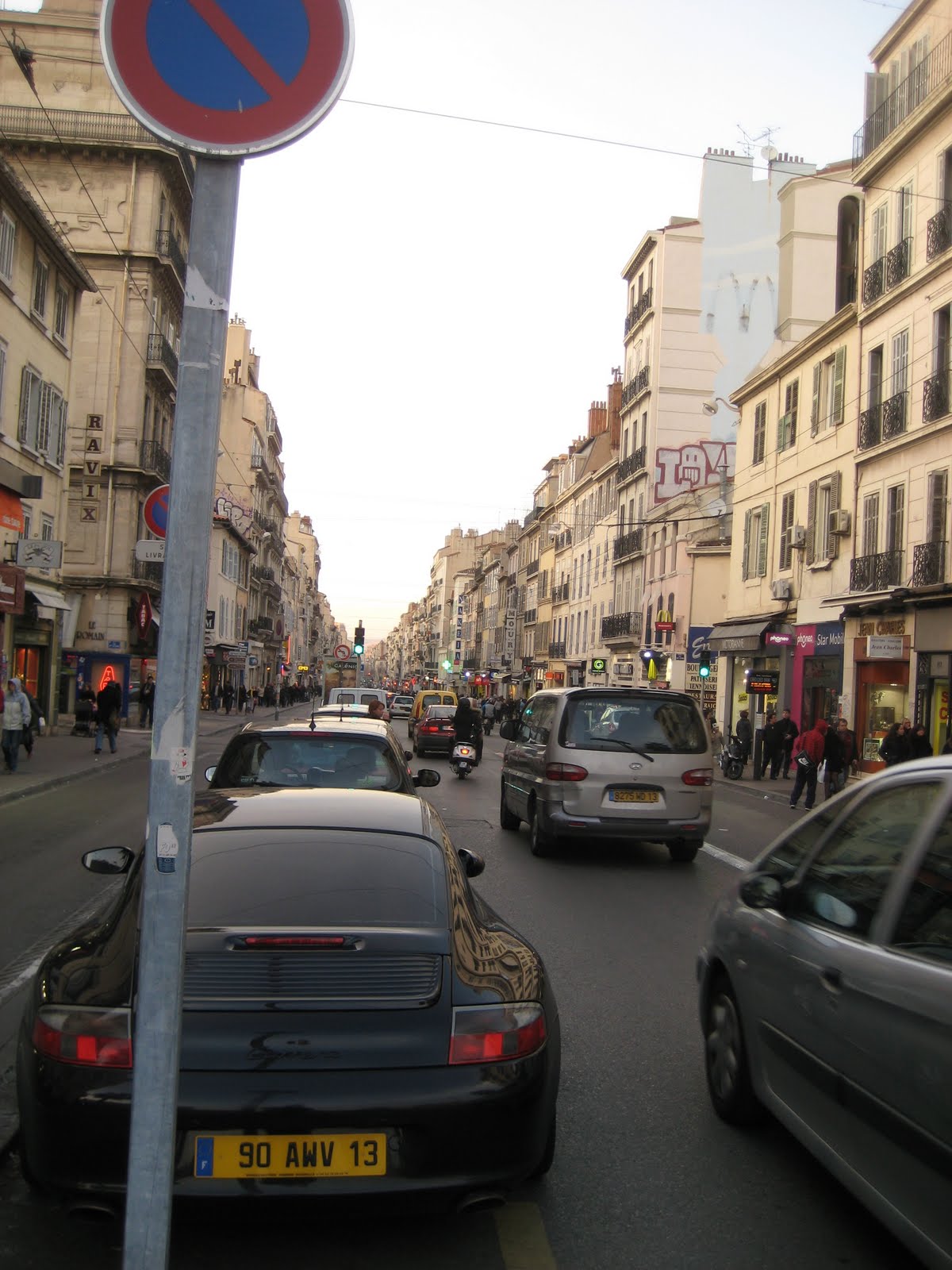 A look down the main road a few blocks from our apartment.
 Las Tortillas. Yep, there's a Mexican restaurant less than 100 yards from our door. How cool is that? Only problem: in a month's time, we've yet to see them open once. And we pass it at least twice a day!
 Au revoir from Super-Sawyer!
Friday, January 28, 2011
When Machines Go On Strike

Today I drove across town to a friend’s house. Throughout Marseille, there is available parallel parking (often on sidewalks), when you can find a spot, marked “payant”. This means that you must pay for parking. After wiggling your car into a spot that’s probably too small, bumping the car in front of and behind you a few times, and wishing for a second you had a smartcar (then remembering just how ridiculous they are), you must find a meter to pay for parking.
 Every block or so there’s a machine marked with a blue P where one can deposit coins and retrieve a small piece of paper authorizing parking for a specified amount of time. That paper, once deposited on your dash, assures you will not be towed. Unless of course there’s a market about to take over the sidewalk.
Back to today’s story...
I parked and I walked to the machine. But when I tried to put coins in, they wouldn’t go. Curious, I pushed a button. Up on the digital screen popped the words en grève. I laughed. The parking meter had just told me that it’s on strike. It could have said en panne, meaning ‘out of order/broken’, but instead it chose ‘on strike’.
What exactly prompts a parking meter to go on strike? Not enough vacation time? Are working conditions not up to par? The 2-hour lunch break not sufficiently long? Too much dog poo nearby?
Subscribe to:
Posts (Atom)

 Posts
Posts

